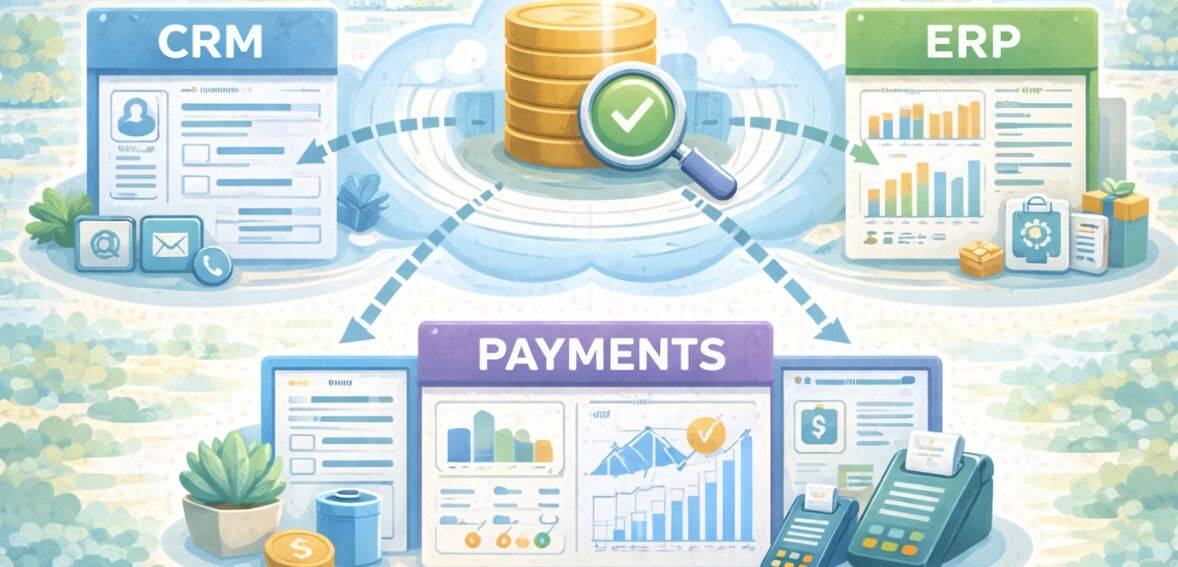
ERP platforms are used by modern firms to manage operations, CRM systems are used to manage relationships, and payment systems are used to transfer funds. Data fractures happen when these systems function independently. Financial numbers are inconsistent, customer records are conflicting, and operational choices are based on incomplete information.
This fragmentation eventually creates risk that is hard to identify but costly to fix. Until reporting errors, reconciliation gaps, or customer complaints arise, leaders frequently believe that inconsistencies are insignificant. A single source of truth is an operational requirement, not a technical luxury.
By ensuring that all departments refer to the same database, it lessens confusion and strengthens accountability. Without it, companies inadvertently base their decisions on conflicting realities rather than common facts.
What “Single Source of Truth” Actually Means

A single source of truth does not mean that one big system will take the place of all others. Rather, it refers to a single authoritative data model that controls the definition, synchronization, and trustworthiness of customer, transaction, and operational data. While CRM, ERP, and payment platforms may continue to operate separately, they must concur on timestamps, business rules, and fundamental identifiers.
Every system regularly updates when a customer modifies their billing information. Finance, operations, and client teams all see the same figures when revenue is reported. Teams may now concentrate on action rather than reconciliation because there is no longer any disagreement about which report is “right.”
The Cost of Conflicting Customer Records
Customer trust slowly erodes when payment systems and CRM don’t agree. An account may appear active to one team but be flagged as delinquent by another. Frontline employees lose faith in internal tools, billing disputes rise, and support tickets rise. These discrepancies eventually result in churn and harm to one’s reputation.
Contact information, billing status, and engagement history are all consistent across systems due to a single source of truth. Faster problem solving and more individualized service are made possible by this uniformity. Consumers are rarely dissatisfied with smooth operations, but they are always aware when systems don’t work together.
Financial Accuracy Starts with Unified Data
Although CRM activity frequently drives revenue recognition, finance teams rely significantly on ERP and payment technologies. Chargebacks, refunds, and income timing may be incorrectly categorized in the absence of synchronization. These mistakes slow closing cycles, skew forecasts, and complicate audits.
Transactions from payment systems into ERP ledgers are guaranteed to flow smoothly and be accessible in CRM records due to a consistent data schema. Stronger internal controls, clearer audits, and accurate reporting are all supported by this alignment. It is not because systems are flawless that financial truth becomes trustworthy, but rather because they are coordinated around common definitions and schedules.
Operational Efficiency and Decision Velocity

Decision-making speeds up when data conflicts are eliminated. Managers no longer have to wait for cross-departmental confirmation or reconciled spreadsheets. When systems communicate with each other, inventory planning, hiring decisions, and customer prioritizing all improve.
Dashboards that reflect reality in almost real time are made possible by a single source of truth. Instead of acting carefully, this clarity enables leaders to take decisive action. Hesitancy is replaced with trust in data, increasing operational velocity. Long-term success in competitive contexts is frequently determined by one’s capacity to act swiftly based on precise information.
CRM as the Relationship Layer
CRM systems are made to record customer intent, communication history, and lifecycle progression. However, they only tell a portion of the story when separated from ERP and payments. Sales, support, and marketing teams can view accurate billing status, order fulfillment progress, and payment behavior when CRM is integrated into a unified data architecture.
Conversations with clients are enhanced by this visibility, which also keeps promises and deliveries in sync. CRM develops into a relationship intelligence layer based on operational and financial truth rather than just a sales tool. A truly unified customer record requires CRM, billing, and support data to work together so teams see a comprehensive, consistent view of every customer.
ERP as the Operational Backbone
ERP systems handle accounting, procurement, inventory, and compliance. Their control and organization are their strongest points. However, real-time customer contact data and payment subtleties are frequently absent from ERP systems. Operations become more responsive when ERP is linked to CRM and payment systems via a single source of truth.
Real sales velocity is reflected in inventory decisions. Accounting records reflect actual consumer behavior. ERP benefits from richer, faster inputs from linked systems while retaining its oversight role. Modern platforms like NetSuite ERP benefits help organizations unify financials, automate workflows, and enhance visibility when integrated with CRM and payment systems.
Payments as the Reality Check

Real-world economic developments are reflected in payment systems. Either money moved, or it didn’t. Payments should therefore serve as a system-wide anchor for truth. Disputes decrease, and reporting gets better when payment data is regularly fed into CRM and ERP.
Accurate client follow-ups are triggered by unsuccessful payments. Refunds automatically reconcile. A single source of truth ensures that payment status is never unclear. Revenue is safeguarded, manual intervention is decreased, and internal and external trust is strengthened by this transparency.
Data Governance as the Foundation
A single source of truth cannot be produced by technology alone. Governance establishes which system is authoritative for each data element, who owns the data, and how disputes are settled. Integrations just accelerate inconsistencies in the absence of oversight.
Long-term stability is ensured by defined definitions, regulated change management, and clear ownership. Integration is transformed from a technical effort into an organizational discipline through governance. Systems can reliably enforce “truth” when everyone agrees on its definition.
Integration Architecture Choices
Businesses frequently have to decide between centralized data centers, middleware systems, and point-to-point interfaces. Every strategy has trade-offs. Point integrations are not very scalable. Flexibility is enhanced with middleware. Data hubs provide analytical capabilities.
Complexity, expansion strategies, and regulatory requirements all influence the best decision. The objective is the same regardless of architecture: authoritative, synced data across payments, ERP, and CRM. Clarity, not complication, should be the goal of architecture.
Real-Time vs. Batch Synchronization
Some data loses value the instant it lags, but not all data must flow instantaneously. Real-time synchronization is frequently required for fulfillment triggers, credit limits, account standing, and payment status. Operational systems and customer-facing personnel must be informed as soon as a payment is successful or unsuccessful.
Other data can be moved in planned batches without any repercussions, such as historical reporting or archival documents. These differences must be made consciously to design a single source of truth. While relying too much on batch updates creates blind spots and delays, overusing real-time sync raises system load and costs.
Stability and immediacy are balanced in mature designs. Confidence that time-sensitive judgments are always grounded in current reality is the goal, not speed for its own sake.
Eliminating Manual Reconciliation at the Root
When systems cannot agree on fundamental facts, manual reconciliation continues. Because they don’t trust dashboards, teams export spreadsheets. Because payment records seem lacking, finance cross-checks CRM data. These actions are coping strategies rather than inefficiencies.
By addressing the underlying problem, a single source of truth eliminates the need for coping. Reconciliation becomes the exception rather than the rule when identities, timestamps, and business rules are unified. This shift has compounding benefits. Closing periods accelerate. Errors decline.
Institutional knowledge begins to reside in systems rather than in the minds of individual employees. Not only does eliminating reconciliation effort save time, but it also rebuilds trust in the organization’s own data.
Audit Readiness and Regulatory Confidence

Audits become more frequent, thorough, and harsh as companies grow. Financial statements, transaction histories, and customer data must all be consistent, according to regulators and auditors. This examination is made easier by a single source of truth, which gives each data point a distinct heritage.
Without the need for human explanation, transactions may be tracked from customer interaction to payment to ledger entry. This traceability minimizes compliance expenses and audit friction. More significantly, audits become routine confirmations of control instead of stressful, reactive procedures.
Because discrepancies are found and fixed well before external evaluation starts, organizations that maintain consistent data structures are rarely caught off guard during audits.
Scaling Without Data Collapse
Every flaw in data design is amplified by growth. Fragmented systems find it difficult to handle the complexity introduced by new product lines, geographies, payment methods, and sales channels. Every expansion generates new discrepancies and laborious workarounds in the absence of a single source of truth.
Scale becomes additive instead of destructive with one. Rather than starting from scratch, new systems integrate with an already-existing foundation. Even as volume rises, reporting is consistent.
Instead of being lost to operational noise, leadership maintains visibility throughout the company. Successful scaling is about making sure that expansion does not shatter the organization’s self-perception, not about adding more tools.
Change Management as the Deciding Factor
Behavioral change is frequently more difficult than technical integration. Workers who are used to “their version” of the data could object to centralized truth, particularly if it reveals mistakes or modifies workflows. This is explicitly addressed in successful implementations.
Leaders need to explain the importance of alignment and how it helps every team. In addition to explaining how systems function, training should emphasize how decision-making is enhanced when everyone has access to the same data.
When teams have fewer disagreements and more transparent results, adoption happens more quickly. The single source of truth is transformed from a mandate into a shared advantage through change management.
Measuring Impact in Business Terms
A single source of truth cannot be justified by IT metrics alone. While uptime and sync success rates are important, they do not provide the whole picture. Faster closures, fewer billing disputes, fewer support calls, better forecasting accuracy, and more customer satisfaction are all signs of true success. Executives are aware of these measures.
The return on investment is evident when departmental friction is reduced by unified data. Integration is reframed as a strategic endeavour rather than a technical cost when impact is measured in this manner. Instead of questioning if alignment is worthwhile, the organization begins to wonder how it managed without it.
Leadership Alignment and Incentives

Unified leadership is necessary for a unified truth. Fragmentation continues when executives rely on disparate reports. Leaders need to use shared dashboards and consistent data to set an example of the behavior they want.
Accuracy and teamwork should be rewarded with incentives rather than the development of workarounds. Teams follow when there is clear leadership alignment. When the truth is upheld from the top, culture changes. Instead of being optional, alignment becomes the norm.
From Accuracy to Strategic Advantage
Organizations can access higher-order value after data accuracy stabilizes. Instead of being predicated on assumptions, strategy is now grounded in evidence. Clear trends become apparent. Trade-offs are confidently assessed. Foresight, not just hindsight, is made possible by unified truth.
At this point, data becomes an offensive instrument for growth and differentiation rather than a defensive one. Organizations that perceive clearly and take decisive action are increasingly gaining a competitive advantage.
Conclusion
Creating a single source of truth for CRM, ERP, and payment systems is an organizational change rather than just a technical integration task. Basically, it changes a business’s self-perception. Making decisions is quicker, calmer, and more assured when financial information, transaction history, and customer records are all in perfect alignment.
Teams no longer waste time arguing about which report is accurate or reconciling figures. Rather, they emphasize improvement, strategy, and action. Consistency is the key to long-term value. Growth without chaos, compliance without fear, and innovation without guesswork are all supported by a single data foundation. With the assurance that insights accurately represent reality, it allows executives to scale operations, implement automation, and utilize analytics.
Above all, it fosters trust with partners, auditors, and customers as well as inside teams. A single source of truth is more than merely an improvement in efficiency in a corporate environment characterized by complexity and speed. Transforming clarity into a long-lasting competitive advantage is a strategic imperative.
FAQs
Is employing a single system for everything equivalent to having a single source of truth?
No. It includes coordinating various systems around common definitions and data integrity rather than substituting them with a single tool.
When creating a single source of truth, which data should be combined first?
The fastest operational and financial impact is usually provided by customer identity, payment status, and revenue records.
After systems are integrated, how do companies avoid data conflicts?
By establishing validation logic, synchronization rules, and data ownership before integration.
Is it feasible for small or mid-sized companies to use this strategy?
Yes. Alignment is possible without enterprise-scale budgets due to phased implementation and contemporary APIs.
How does a single source of truth support future automation and AI?
Accurate, consistent data ensures automation behaves correctly, and AI insights are reliable rather than misleading.
Leave a Reply